Beneath the volcanic ash that has shielded Pompeii for nearly two millennia, a lavish dining chamber has emerged adorned with stunningly preserved wall paintings. These frescoes portray the Dionysian Mysteries — clandestine religious ceremonies honoring Dionysus, the Greek deity associated with wine, ecstasy, and rebirth. The imagery offers an exceptionally rare window into rites that ancient participants guarded with their lives.
Inside the House of Thiasus
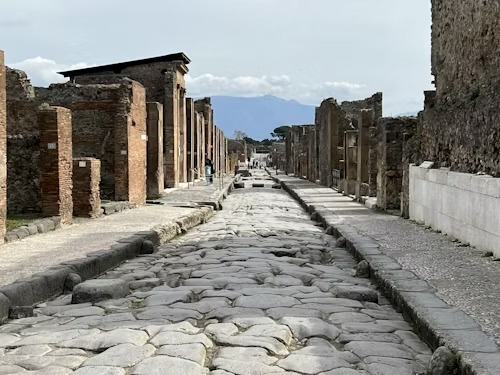
Researchers have dubbed the newly revealed structure the House of Thiasus. It sits within a neighborhood of Pompeii still undergoing systematic excavation. Across three walls of what appears to have been an opulent dining space, vibrant painted scenes unfold in remarkable detail. The fourth wall originally opened onto a private garden, a design hallmark favored by wealthy Roman homeowners.
The compositions feature a procession of devotees — satyrs coaxing music from reed flutes, maenads pouring libations of wine, and other figures performing ritualistic acts. The artistic execution is extraordinary, with colors that remain vivid and figures rendered with a sophistication that speaks to the considerable wealth and refined taste of the property\’s owner.
Decoding Forbidden Ceremonies
Among the ancient Mediterranean\’s most fiercely protected religious traditions, the Dionysian Mysteries demanded absolute silence from initiates. Anyone who revealed the details of the ceremonies risked execution. That enforced secrecy is precisely why so few written accounts have survived the centuries.
What sets the Pompeii paintings apart is their apparent depiction of authentic ritual sequences rather than purely mythological tableaux. Specialists studying the imagery believe the scenes may represent successive stages of initiation into the cult, potentially making this the most comprehensive visual documentation of these ceremonies ever uncovered.
Sealed by Catastrophe, Saved for Posterity
The eruption of Mount Vesuvius in 79 CE devastated Pompeii but simultaneously acted as a preservative time capsule. Layers of superheated ash and pumice stone entombed the city\’s structures and artwork, shielding them from the natural deterioration that erased comparable paintings elsewhere throughout the Roman world.
Officials at the Pompeii Archaeological Park have indicated that the House of Thiasus will eventually welcome visitors, although extensive conservation efforts must be completed first — a timeline measured in years rather than months.
Related Discoveries