For more than a hundred years, the Valley of the Kings has kept its greatest secrets buried. That silence was shattered in early 2025 when a team of archaeologists announced the identification of a royal burial belonging to Pharaoh Thutmose II, an 18th Dynasty ruler who governed Egypt roughly 3,500 years ago. Nothing of this magnitude has emerged from the valley since Howard Carter pried open Tutankhamun\’s sealed chambers back in 1922.
The Overlooked Pharaoh
Thutmose II held the throne for a comparatively short stretch, from approximately 1493 to 1479 BCE. History has largely eclipsed him in favor of his far more celebrated wife and eventual successor, Hatshepsut, one of the rare women to claim the title of pharaoh. His final resting place had eluded researchers for generations, remaining among Egyptology\’s most persistent unsolved riddles.
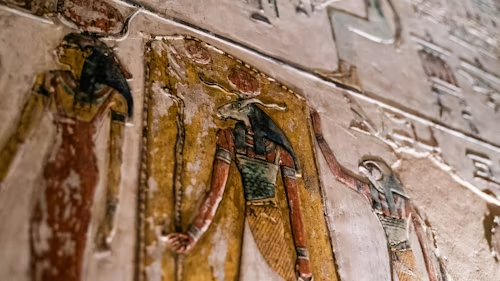
Polish archaeologist Andrzej Niwinski led the excavation team that initially suspected they had uncovered the burial of a lesser royal figure. As the dig progressed, however, the sheer volume and quality of funerary objects painted an entirely different picture. Gilded wooden furniture fragments, canopic vessels, and ceremonial decorations bearing royal cartouches left no doubt: this was the resting place of a king.
Treasures From the Burial Chamber
Inside the tomb, researchers cataloged a remarkable collection of objects that shed fresh light on how royals were interred during the early 18th Dynasty. Gold-leaf-adorned wooden furniture pieces, ceramic vessels still bearing traces of ritual food offerings, and carved stone fragments all contributed to confirming the identity of the occupant.
Mohamed Ismail Khaled, who serves as secretary-general of Egypt\’s Supreme Council of Antiquities, characterized the find as among the most consequential archaeological breakthroughs in recent memory. He emphasized that this marked the first time scholars had successfully identified the complete funerary assemblage of this particular ruler.
A Window Into Dynastic Power
Beyond the objects themselves, the tomb fills a significant void in scholarly understanding of the 18th Dynasty, widely regarded as one of ancient Egypt\’s most influential and militarily dominant eras. The placement of the tomb and its architectural design offer new clues about how the valley\’s necropolis was organized and how specific burial plots were allocated among members of the royal household.
Conservation specialists are now painstakingly documenting and preserving every item recovered from the site, a meticulous process likely to span several years. Preliminary examinations suggest that while tomb raiders disturbed the burial at some point in antiquity, enough material survived to substantially deepen our knowledge of this pivotal historical period.
Related Discoveries