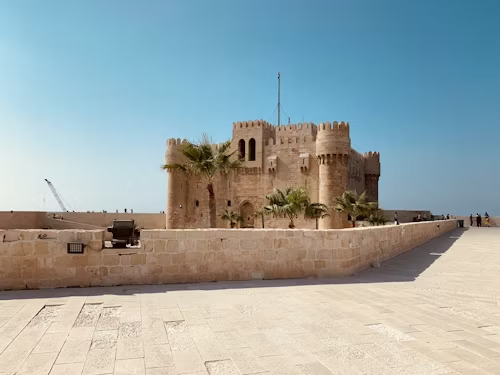
One of archaeology\’s most tantalizing cold cases may finally be warming up. A joint expedition led by Egyptian archaeologist Kathleen Martinez and deep-sea exploration pioneer Robert Ballard has mapped a submerged ancient harbor adjacent to the temple complex at Taposiris Magna, roughly 45 kilometers west of Alexandria. The team is convinced these underwater ruins could harbor decisive clues pointing to the long-lost tomb of Queen Cleopatra VII.
A Civilization Swallowed by the Sea
Deploying cutting-edge submarine mapping technology, the researchers surveyed the seabed bordering the temple and identified an entire sunken landscape: ceramic transport jars, multiple stone anchor points, a polished stone pavement, and towering architectural columns — the unmistakable skeleton of a major port facility consumed by the Mediterranean over two millennia of seismic activity and sea-level rise.
A paved promenade connecting the temple\’s northern entrance to the coastline was also documented, reinforcing the case that the temple and the now-vanished harbor were designed as an integrated architectural ensemble.
Eighteen Years of Conviction
Martinez has devoted more than 18 years to building the argument that Taposiris Magna is where Cleopatra and her Roman consort Mark Antony were laid to rest. Her reasoning draws on several converging threads: the temple honored Osiris and Isis, deities Cleopatra personally identified with, and classical sources describe her selecting a burial site near a sanctuary of Isis.
Earlier digs at the location uncovered a honeycomb of subterranean passages, a Ptolemaic-era burial ground, and coins stamped with Cleopatra\’s likeness — each piece strengthening the temple\’s ties to Egypt\’s final pharaoh.
The Eternal Riddle
Cleopatra died in 30 BCE, traditionally said to have taken her own life after her forces fell to the Roman commander Octavian. Ancient chroniclers affirm she received a royal burial, yet no one has ever pinpointed where. The Taposiris Magna evidence now stands as the most credible lead in generations, though confirming the theory demands years of continued underwater and terrestrial excavation.
Related Discoveries