
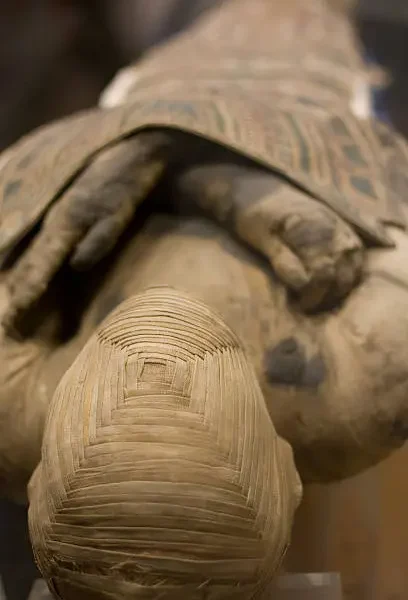
In one of this year\’s more unexpected scientific revelations, a research team publishing in the Journal of the American Chemical Society has demonstrated that ancient Egyptian mummies continue to emit identifiable — and surprisingly agreeable — fragrances even after resting in sealed stone coffins for up to five millennia.
Unraveling the Chemistry of the Afterlife
The investigators analyzed volatile organic compounds emanating from mummified tissue and the embalming materials encasing it. They detected a sophisticated cocktail of natural ingredients: beeswax, botanical oils, tree resins, and mineral bitumen — the same substances cataloged in ancient Egyptian instructional texts on the mummification craft.
The genuine surprise was that many of these compounds had retained their aromatic character across thousands of years. Resins derived from pine, cedar, and frankincense trees proved particularly resilient, yielding recognizable and often pleasant scent profiles when subjected to gas chromatography and mass spectrometry analysis.
Perfumery With a Spiritual Purpose
These findings indicate that Egyptian embalmers were not simply preserving flesh; they were intentionally engineering specific olfactory experiences as part of the sacred preparation for the afterlife. Ancient Egyptians believed pleasant aromas held divine significance, associating fragrance directly with the gods and regarding aromatic substances as essential agents of spiritual purification for the deceased.
Intriguingly, the particular blend of resins and oils differed from mummy to mummy, raising the possibility that embalmers customized their recipes according to the social rank of the individual or that formulations evolved as techniques were refined across different historical periods.
Recovering the Sensory Past
This research exemplifies an emerging trend toward sensory archaeology — the effort to reconstruct not just what ancient peoples saw and touched, but what they smelled, tasted, and heard. By decoding the molecular makeup of ancient materials, scientists can recreate fragrances that no living person has experienced for thousands of years.
Several major museums have already expressed enthusiasm about developing scent-based exhibitions, introducing visitors to reconstructed Egyptian aromatics and adding an entirely new sensory dimension to our engagement with the ancient world.