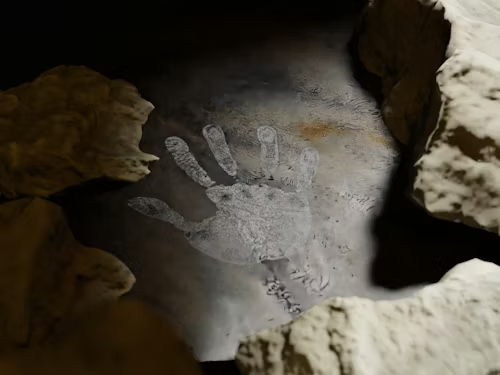

A modest stone pulled from a Spanish rock shelter may force us to rethink when artistic expression first began. Scientists have identified a deliberate fingerprint, pressed into red ochre pigment on the stone\’s surface approximately 43,000 years ago. The compelling twist: it was almost certainly made by a Neanderthal, which could make it the earliest known example of intentional symbolic art on record.
Not an Accident, But a Statement
The stone, roughly the size and shape of a potato, was excavated from a Middle Paleolithic site in central Spain known to have been occupied by Neanderthals. What captured researchers\’ attention was not merely the pigmented mark itself but its precise positioning. The ochre-daubed fingerprint sits squarely at the center of one face of the stone, placed in such a way that the surrounding natural contours resemble a rudimentary human face — a perceptual phenomenon called pareidolia.
The scientific team contends this placement was fully intentional. They argue the Neanderthal who created it perceived the face-like character of the stone and chose to accentuate that illusion by adding the fingerprint as a focal element, effectively crafting a primitive portrait.
Overturning Outdated Prejudices
A longstanding assumption in the scientific community held that Neanderthals lacked the cognitive sophistication necessary for symbolic reasoning. This discovery joins a rapidly growing catalog of evidence dismantling that outdated narrative. In recent years, researchers have documented Neanderthal cave paintings in Spain, ornamental jewelry fashioned from eagle claws, and funeral rites suggesting surprisingly nuanced social structures.
The ochre fingerprint from Spain now pushes the chronological boundary of symbolic behavior thousands of years further into the past, and does so in a Neanderthal context rather than a modern human one — a detail that carries enormous implications.
Rethinking What Made Us Special
Should the research team\’s analysis hold up to further scrutiny, the ramifications for our understanding of Neanderthal cognition are profound. Recognizing pareidolia in a natural object and then deliberately modifying that object to amplify the effect demands abstract reasoning, creative imagination, and purposeful intent. These are exactly the mental faculties long assumed to belong exclusively to Homo sapiens.
The discovery hints that the artistic impulse may be far more ancient than our own species, perhaps shared with our closest evolutionary cousins who inhabited the Earth for tens of thousands of years before modern humans ever set foot in Europe.
Related Discoveries