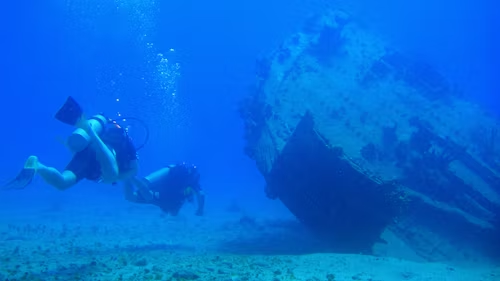
The French Navy has identified a sixteenth-century trading vessel resting on the Mediterranean seabed at a depth of 2,567 meters — the deepest shipwreck ever located within French territorial waters. Designated Camarat 4, the wreck was detected during a routine underwater survey off the coast of Ramatuelle along the French Riviera.
Preservation in the Abyss
At two and a half kilometers beneath the surface, conditions are paradoxically ideal for preservation. The near-total absence of light, bone-chilling temperatures, and immense water pressure create an environment hostile to the wood-boring marine organisms and strong currents that ravage shallower wrecks. As a result, Camarat 4 has retained a remarkable amount of its original structure across five centuries.
Acoustic imaging and footage captured by remotely operated submersibles reveal a ship roughly 20 meters in length, consistent with Mediterranean cargo vessels of the 1500s. Ceramic containers scattered in the debris field likely represent the remnants of the ship\’s commercial payload — possibly wine, olive oil, or other commodities that flowed along Renaissance-era maritime routes.
Technological Frontiers Enable Discovery
Locating a wreck at this depth would have been inconceivable just a few decades ago. Advanced multibeam sonar systems, capable of mapping the ocean floor with extraordinary precision even at extreme depths, made the detection possible. The French Navy primarily deploys this technology for defense purposes, but archaeological discoveries are a welcome secondary benefit.
Physically retrieving artifacts from 2,567 meters below the surface remains technically feasible but prohibitively expensive. For the foreseeable future, researchers will study the wreck remotely using high-definition imaging.
Echoes of Renaissance Trade
The vessel\’s resting place aligns with established Mediterranean commercial corridors that linked ports in Italy, France, the Iberian Peninsula, and North Africa during the 1500s. Merchant ships plying these waters contended with violent storms, piracy, and the ever-present risk of navigational error; thousands perished over the centuries. Each sunken hull encapsulates a single suspended moment in maritime history, and Camarat 4\’s extraordinary state of preservation may eventually unlock valuable details about shipbuilding methods, cargo networks, and seafaring life during the Renaissance.
Related Discoveries