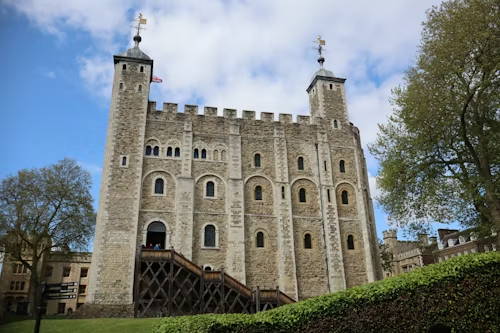
Sustained excavations at the Tower of London — one of England\’s most symbolically charged historical landmarks — have produced a cascade of discoveries: a mass grave from the Black Death pandemic of the 14th century, coffined burials of apparent elites from the medieval period, and structural evidence suggesting certain sections of the fortress are older than anyone previously realized.
When the Plague Overwhelmed London
The most viscerally striking find is a communal burial pit dating to the Black Death outbreak of 1348 to 1350, a pandemic that extinguished roughly 15 percent of London\’s entire population within two devastating years. Densely stacked skeletal remains, deposited without individual caskets or identifying markers, bear silent witness to a catastrophe so immense that the city\’s burial customs simply collapsed under the weight of the dead.
Laboratory work on the recovered bones and dental samples is generating fresh data on the nutritional status and overall health of medieval Londoners. DNA extraction has positively identified Yersinia pestis, the plague-causing bacterium, in multiple skeletons from the pit.
Burials Befitting the Powerful
A separate excavation zone has yielded coffined interments of individuals who clearly occupied elevated social positions, dating to the 12th and 13th centuries. The craftsmanship of the coffins and their placement within the Tower grounds point to persons of real consequence — potentially courtiers, senior clergy connected to the Chapel of St. Peter ad Vincula, or other figures in the orbit of the crown.
An Even Older Fortress?
For architectural historians, the most provocative finding may be evidence that construction at the Tower complex commenced during the reign of Henry I in the early 1100s — pushing the accepted building chronology backward. If confirmed, this would make the fortress even more venerable than its already formidable documented history suggests, indicating that England\’s Norman rulers prioritized London\’s fortification almost immediately after William the Conqueror\’s arrival.
The excavation project has several more planned seasons of fieldwork ahead, with each new trench expected to deepen an already richly layered understanding of this iconic site.