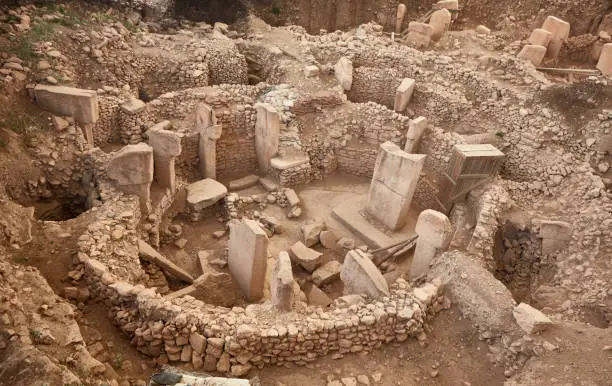
Deep in the rolling landscape of southeastern Turkey, the ancient site of Karahantepe has produced a discovery that defies conventional timelines of human achievement. Excavators have unearthed a colossal circular stone structure dating between roughly 9400 and 8000 BCE — an era when humanity had not yet learned to cultivate crops. Its design bears an uncanny resemblance to the amphitheaters that Greek and Roman civilizations would construct thousands of years later.
Architecture That Shouldn\’t Exist
Spanning close to 17 meters across, the structure features graduated stone seating arranged in a sweeping semicircle. Carved sculptural elements are integrated directly into the walls, including human and animal figures that seem to push outward from the rock itself. The craftsmanship is strikingly refined for its age — faces bear individualized features, bodies are carefully proportioned, and recurring symbolic motifs suggest an established artistic vocabulary.
The design predates not only monumental architecture elsewhere in the world but also pottery, writing systems, and organized farming. For a society still subsisting entirely on hunting and foraging, the ability to envision and execute a project of this complexity is remarkable.
Companion to Göbekli Tepe
Karahantepe lies just 35 kilometers from Göbekli Tepe, the celebrated Neolithic complex whose discovery in the 1990s overturned longstanding assumptions about early human capability. Together, these sites anchor a broader network of monumental stone constructions scattered across the region, all of which predate Stonehenge by roughly six millennia.
Where Göbekli Tepe is defined by its imposing T-shaped pillars enclosed within stone rings, Karahantepe appears to have served a distinct yet complementary role. The amphitheater layout implies large-scale communal gatherings, possibly for ritual observances, collective ceremonies, or group decision-making.
Challenging the Textbook Narrative
Traditional models of human progress assumed that large-scale construction could only emerge after agricultural surpluses freed communities from the constant demands of finding food. Karahantepe, much like its neighbor Göbekli Tepe, upends that reasoning by demonstrating that pre-farming societies mobilized substantial labor forces to erect permanent monuments long before the first seeds were deliberately planted.
Fieldwork at the site continues, and the research team suspects that vast portions of the complex remain concealed underground, awaiting future seasons of excavation to reveal additional chapters of humanity\’s deep past.
Related Discoveries